Showing posts with label Faberge. Show all posts

Sunday, March 27, 2016

On this Easter Sunday, while the West is warm and sunny, while my Eastern and Central Canadian friends are still struggling with ice-storms, blizzards, snow-blocked roads, what is more appropriate than the Imperial Winter Egg?


This egg, from 1913, is made of carved rock crystal thin as glass - so thin the surprise is visible (albeit clouded). The egg is engraved with frost-flowers and ornamented with platinum and diamonds. The base is rock-crystal carved to resemble a block of melting ice. 


The surprise, so suitable for Spring spreading across the country even where the land seems most winter-locked, is a platinum basket of flowers. 

Resembling the early-Spring anemone blossoms, these are made from white quartz, nephrite, gold and green garnets, set in a bed of moss made of green gold. 

With that materials list, it may not surprise anyone to learn this was the most expensive Imperial Egg of the lot, for all its apparent simplicity. It was an Easter gift from Tsar Nicholas II to his wife, Tsarina Maria Feodorovna. 


References:

 http://archive.constantcontact.com/fs139/1102377331844/archive/1112504496737.html

 http://www.faberge.com/news/49_imperial-eggs.aspx\
https://s-media-cache-ak0.pinimg.com/236x/5f/46/35/5f4635fd9056ba68503e85782a49ca22.jpg

Saturday, March 26, 2016

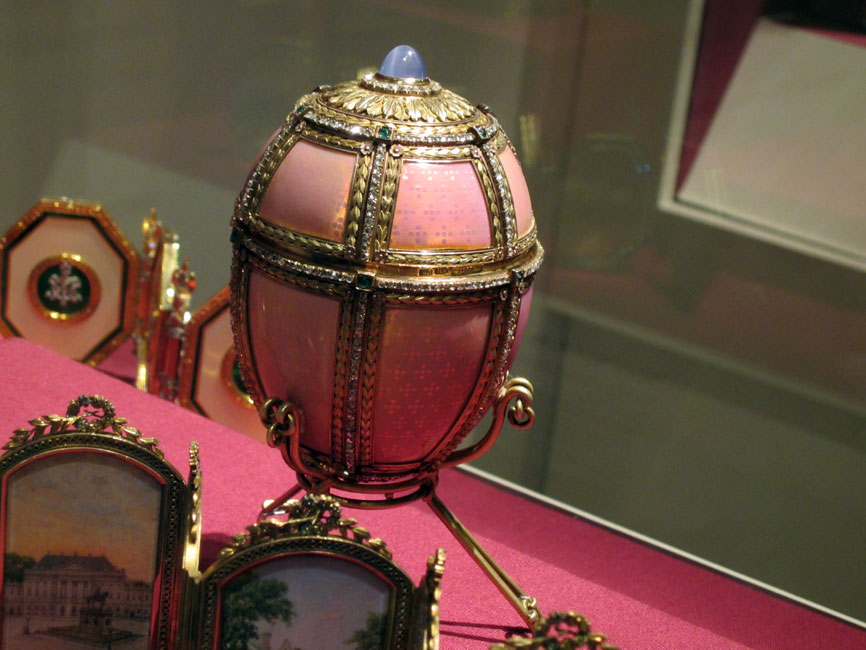
 A wee leap backward in time, from 1898 to 1890, the year the Tsarina Maria Feodorovna, born Princess Dagmar of Denmark, received the Danish Palaces Egg from her husband, Tsar Alexander III. 


The egg is gold, enameled in pink-mauve. Emeralds mark the intersections of lines of rose-cut diamonds. The crown is a medallion of leaves around a star sapphire; additional leaves curl up from the bottom. Originally the egg sat on those leaves; the stand is a more modern construction.

The surprise here is a set of 10 miniature watercolours painted by Konstantin Krijitski, showing the Tsarina's favourite Danish and Russian retreats, mostly palaces but including the Imperial yacht. The Tsar apparently threw himself into enjoying their summer getaways to Denmark, where he could let his formality lapse and play in the mud with his children. 


References:

http://cerebralboinkfest.blogspot.ca/2011/05/whats-in-name.html
http://www.artloversnewyork.com/zine/the-bomb/2012/09/07/family-jewels-at-the-met/http://www.artonstamps.org/Countries/Liechtenstein/Easter/faberge-5.jpg
 https://en.wikipedia.org/wiki/Danish_Palaces_Egg

Wednesday, March 23, 2016

For the year of Maddie's first published adventure (1898), here's the lovely 'Lilies of the Valley' Imperial Egg presented to Alexandra Feodorovna by Nicholas II.

"This gold, art-nouveau style egg is enameled translucent rose on a guilloche field and supported on four dull green-gold cabriolet legs, composed of overlapping leaves veined in rose-cut diamonds. The egg is surmounted by a rose-cut diamond and cabochon ruby Imperial crown set, with two bows and quartered by four lines of rose-cut diamonds and decorated with lilies of the valley in pearls and rose-cut diamonds. The stalks are lightly engraved green gold, and the leaves are enameled translucent green on gold."

"The surprise consists of three oval miniatures of Nicholas II in military uniform and the Grand Duchesses Olga and Tatiana, his first two children. It rises from the top of the egg by means of a geared mechanism and spreads into a fan when a gold-mounted pearl button at the side is turned. A turn in the opposite direction automatically folds and returns the miniatures back to the interior of the egg. The Julian date, April 5, 1898, is engraved on the reverse of the miniatures. Johannes Zehngraf painted the miniatures on ivory; the egg retains its original fitted velvet case."

http://www.alexanderpalace.org/palace/lillies.html


To see the Egg in the round, check out the video


We're coming up to Easter and, as I'm developing a Russian character for Maddie's second adventure, research and inclination alike lead me to Faberge Imperial Eggs. 

These glorious gifts, all egg-shaped, all stunningly detailed, and each containing a surprise, were presented to the Tsarina Maria Feodorovna each Easter in joint commemoration of her birthday and Easter, first by her husband, Tsar Alexander III, and then by her son, Tsar Nicholas II.

Not all of the 50 Imperial Eggs have been found since the Russian Revolution in 1917 (99 years ago). I'll post just a few of my favourites in the lead-up to Easter.

To start, since we're still recovering from St. Patrick's Day, the Imperial Faberge Clover Leaf Egg,presented by Nicholas II to his wife, the Empress Alexandra Feoderovna (born Alix of Hesse) for Easter 1902.


This Egg, which remained in Russia throughout the Revolution and is still there, was constructed in the plique-a-jour* style, meaning you can look through the surface layers of three and four leaf clovers (some in green enamel with veining of gold in relief and some diamond studded) to the interior. A red enamel ribbon runs through the leaves  The Egg has a delicate, clover-footed stand. The inner surprise, which went missing during the Revolution, was a four leaf clover with portraits of the four Grand Duchesses, daughters of Nicholas and Alexandra.

Isn't that lovely way to celebrate?

References:
http://www.christopherevansgoldsmiths.com/story-faberge-easter-eggs/
http://www.mirror.co.uk/news/uk-news/hunt-priceless-faberg-lost-easter-5455842
https://en.wikipedia.org/wiki/Faberg%C3%A9_egg